1980Charles AubertFrench
Family history
Aubert de la Rüe

Two families, one name
Spelling has varied through history: hyphens, capitals, the dieresis over the u. “Aubert de la Ruee” is used online so the ü is not lost.
Forty generations
- c. 580
Birth of Pépin of Landen, mayor of the palace of Austrasia (died 640) — the earliest recorded ancestor, forty generations back, reached through Charlemagne, the counts of Namur and Hainaut, the lords of Beaujeu and the counts of Valentinois.
- c. 1125
Aymar I, the first known of the house of Poitiers, counts of Valentinois.
- 1202
The de Vesc appear in the documents of the Dauphiné.
- 1425
Jehan Pasteur holds the estate of Saint-Maurice near Geneva.
- c. 1530
Vincent Aubert is born, landowner at Manas in the Dauphiné — the first of the Aubert line.
- 1579
Gaspard De la Rüe is received as a resident of Geneva.
- 1707
Jacques Aubert is received as a resident of Geneva; the Aubert settle in the city.
- 1842
Hippolyte De la Rüe buys La Tour at Crassier; Charles Aubert buys the estate he names Vermont.
- 1906name
On 17 April 1906 the Conseil d’État of Geneva authorises Hippolyte Aubert and his descendants to add De la Rüe to their name, in memory of his mother, the last of the De la Rüe.
- 1980gathering
The family meets at Crest and Grâne on 10 and 11 May, 450 years after the birth of Vincent Aubert.
How far each line reaches
- c. 580
The Carolingians — from Pépin of Landen through Charlemagne (35 generations back), the counts of Namur and Hainaut, the lords of Beaujeu and the counts of Valentinois to Catherine, natural daughter of Louis II, the last count, who married Guillaume de Vesc, lord of Espeluche, before 1419 — and from the de Vesc to Marie Blache, mother of Jacques Aubert (born 1677). Ruling houses were recorded in chronicles and charters because crowns and lands passed by descent.
- c. 1125
Poitiers, counts of Valentinois — first attested in the cartulary of the abbey of Léoncel; counts until the death of Louis II in 1419, when the county passed to the Dauphin.
- 1202
De Vesc, lords of Espeluche in the Dauphiné — known from acts of homage, fiefs and war service; their genealogy was printed by Pithon-Curt in 1750 and by La Chenaye-Desbois.
- 1421
Pasteur — landowners at Saint-Maurice near Geneva, then in the Duchy of Savoy; citizens of Geneva from 1633.
- c. 1530
Aubert — landowners at Manas near Crest, known from notarial deeds such as Vincent Aubert’s will of 1584.
- c. 1530
De la Rüe — Simon De la Rüe appears in the tax registers of Lessines in Hainaut among its richest men; from 1574 the family is in the registers of Geneva.
- 1645
Heath — weavers of Exeter, in the parish registers of Holy Trinity and the rolls of the weavers’ guild.
- 1735
Wikberg — in Ostrobothnia, Finland, in the Lutheran parish registers that the Swedish Church Law of 1686 made compulsory.
Huguenots and Geneva
- 1574
Gaspard De la Rüe, eighteen and penniless, reaches Geneva from Lessines, fleeing the Duke of Alba’s persecution in the Spanish Netherlands; his son Louis becomes First Syndic.
- 1584
At Crest, the Catholic Vincent Aubert disinherits his son Jacques for joining the Reformation. The family splits into a Catholic and a Protestant branch.
- 1633
The Pasteur, Protestants from Saint-Maurice in Catholic Savoy, become citizens of Geneva.
- 1685
Louis XIV revokes the Edict of Nantes. Eight of the eleven children of Vincent Aubert and Marie Blache leave Crest for Geneva; their mother, too old for the road, stays and refuses to abjure.
- 1708
Jacques Aubert, a refugee, becomes a burgess of Geneva; he marries Jeanne Privat, of a refugee family from Nîmes.
The Aubert of Crest and Geneva bear three black hounds’ heads — sleuth-hounds — on a gold shield. The Aubert-De la Rüe quarter them with the De la Rüe demi-lion holding a rose.
Invisibilia non decipiunt“The things unseen do not deceive.” The original motto was Fide et fortitudine, by faith and courage, until the Aubert of Geneva changed it.
Arms of the families the Aubert married into, and of the medieval houses from which they descend.
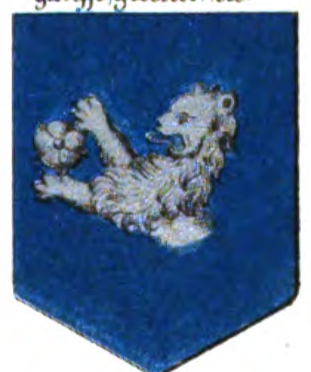
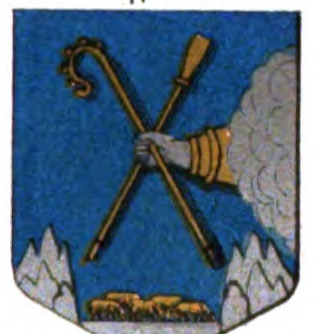
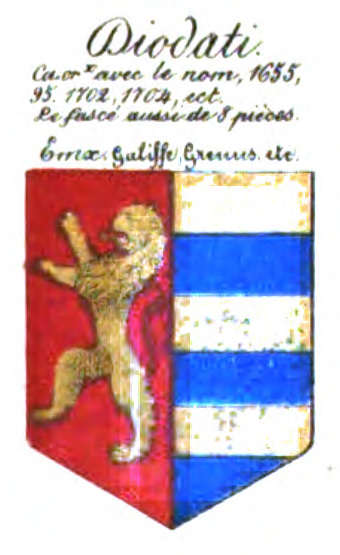
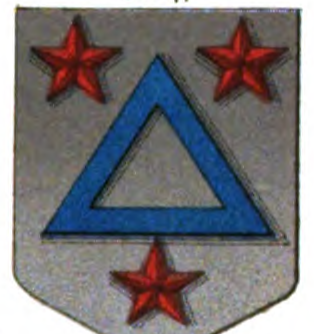
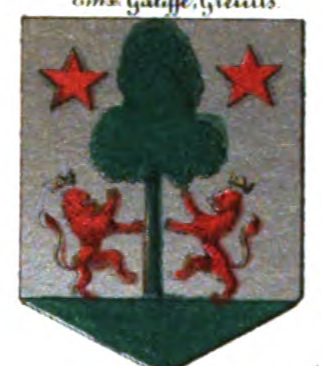
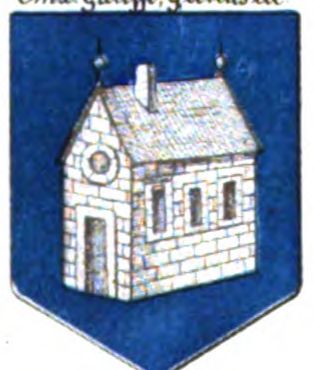
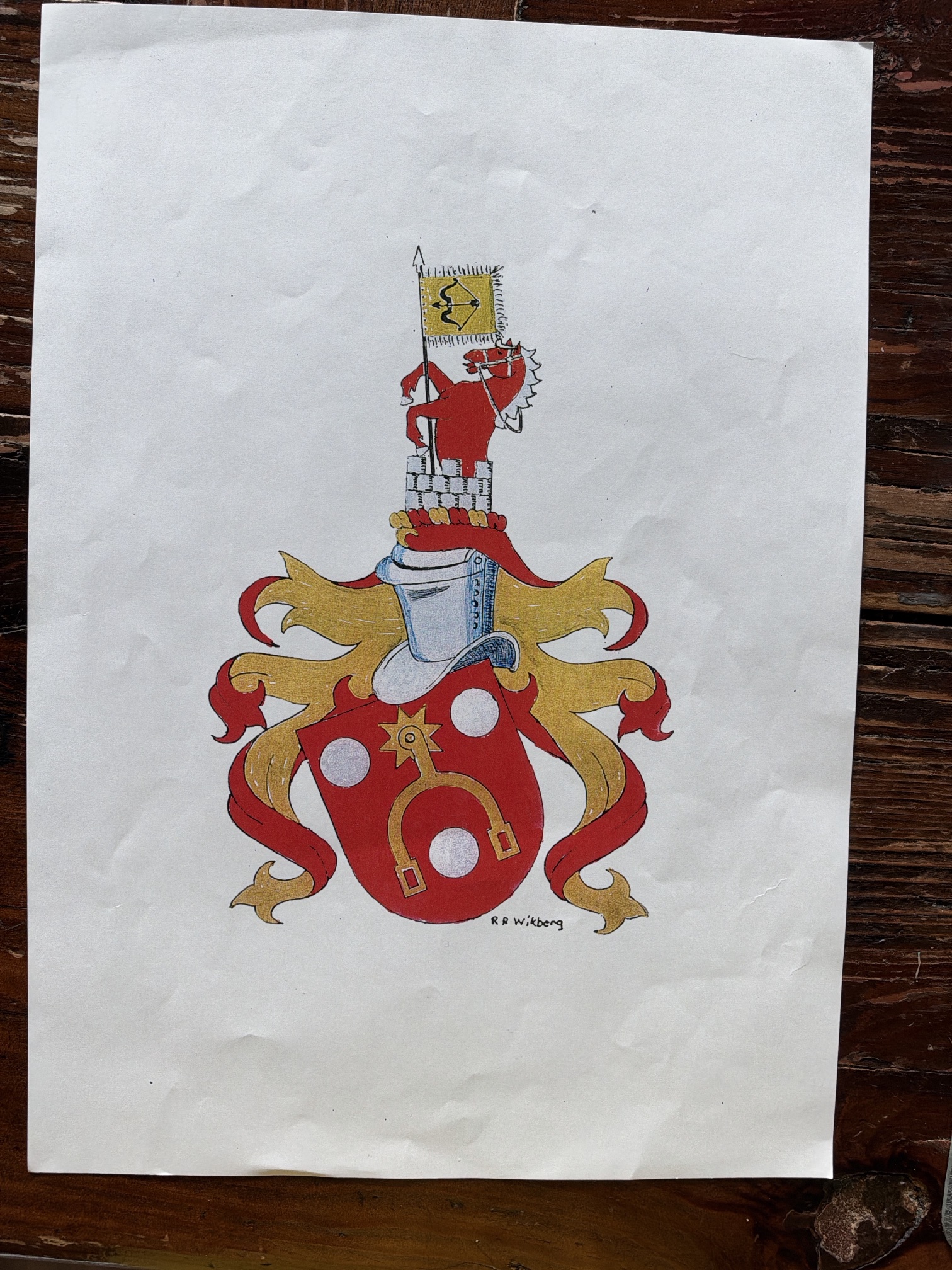


Shields after the Armorial historique genevois (1859), R. R. Wikberg and Wikimedia Commons (Syryatsu; S@m and Bruno Vallette, CC BY-SA 3.0; Flying jacket; Tom-L).
References
The research rests on these family genealogies and on the older printed works listed below them.
1984Charles AubertPayot, French
Les De La Rüe, marchands, magistrats et banquiers. Genève, Gênes, 1556–1905
c. 2014Nicole and André CasalisFrench
L’Arbre du Temps, Tome IV
2002 / 2008Rolf Aubert de la RüeGerman, unpublished
Die Familie Aubert de la Rüe von Genf
2000R. R. Wikbergone sheet
Wikberg family chart
Older printed works: Galiffe, Notices généalogiques sur les familles genevoises (1836); Drake, Heathiana (1881); Boislisle on Étienne de Vesc (1884); Brun-Durand, Dictionnaire de la Drôme (1901); La Chenaye-Desbois, Dictionnaire de la noblesse; the Bulletin of the Drôme archaeological society (1866–1911); Chevalier on the counts of Valentinois (1897).
Do you know more?
If you hold a date, a photograph, a letter or a family story, write to the research desk. Please say which family you are writing about.
The address is not written into the page. It appears on request, so that mail robots do not collect it.
Every person, source and photograph
The archive holds over 1,500 people, with the source for each statement, their coats of arms and residences on a map, and the photographs of the pages, portraits and objects behind them.
Open the archiveAubert de la Rüeinvisibilia non decipiunt